
Land Promotion Agreements in County Down
With promotion, you keep your land in County Down while Land to Homes pays for the surveys, design and planning application. There is nothing to pay upfront: costs are recovered from the sale proceeds only if the land sells with planning. A minimum price agreed at the start means you are not obliged to sell below that figure.
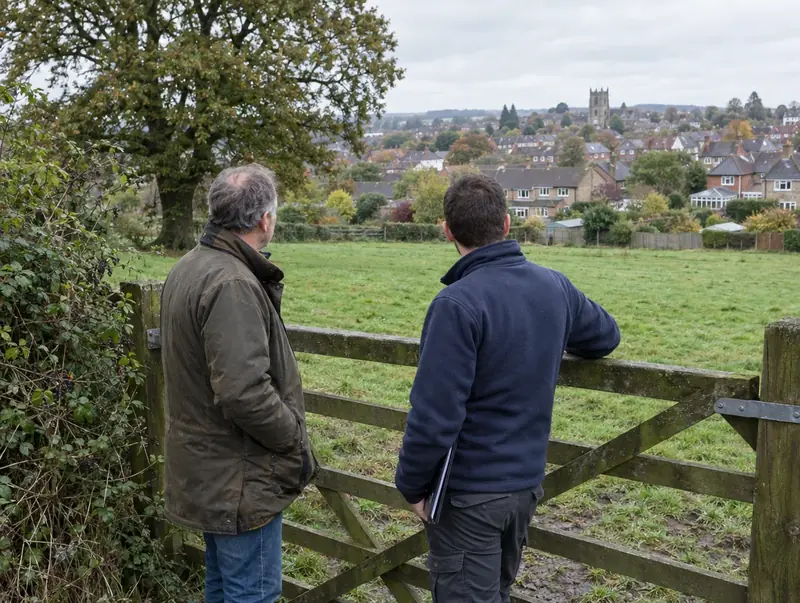 County Down
Free site appraisal
Tell us about your land and we will call you back. No cost, no obligation.
Prefer to talk? Call 0800 088 6248.
- Free site appraisalNo cost, no obligation
- Legal fees coveredReasonable fees, on options and promotion
- Nothing to pay upfrontOn promotion: we fund planning
- Direct purchaseSuitable sites, with or without planning
- UK-wideEngland, Wales, Scotland and NI
Land we look at around County Down
Our County Down coverage takes in 6 towns and cities, centred on Bangor (County Down) and including Banbridge, Downpatrick and Newtownards. Neighbouring areas we also cover include County Antrim, County Armagh and County Tyrone.
Typical sites we review near County Down include paddocks on the edge of Bangor (County Down), redundant agricultural buildings and brownfield land in and around Bangor (County Down). Planning in County Down follows Northern Ireland’s rules: the Strategic Planning Policy Statement sets national policy and the council’s Local Development Plan sets local policy.
Send us a postcode in or near BT20 and we will start with a free desktop appraisal.
Our approach in County Down
Planning work funded by us
Nothing to pay upfront: on promotion we fund the planning work. Those costs are recovered from the sale proceeds only if the land sells with planning, and the heads of terms set out exactly how that works.
Clear fee and cost rules
The heads of terms state the fee, which costs can be recovered and whether any cap applies, so you can see what will come out of the proceeds before you sign.
Retained land protected
If you keep neighbouring land, the agreement can secure access and services to it, so the new scheme does not cut off the rest of your holding or limit its future use.
Strategic planning work
Larger sites often need representations to the development plan, studies on transport, drainage and ecology, and engagement with the local community. We manage that work and report progress to you.
The Northern Irish system, as it applies in County Down
Selling land near County Down follows a familiar pattern in Northern Ireland: heads of terms, then an exchange of contracts signed by both sides, which makes the sale binding, and completion. The buyer pays Stamp Duty Land Tax, as in England, and the title is registered with Land Registry, part of Land & Property Services, although older titles may first need moving from the Registry of Deeds. Infrastructure and affordable housing are usually secured through a Section 76 planning agreement.
In Northern Ireland, larger sites generally need zoning for housing in the council's local policies plan, which follows its adopted plan strategy. Regionally significant proposals are decided by the Department for Infrastructure. Promotion work should allow for Section 76 obligations, DfI Roads requirements and wastewater capacity, which can be a constraint in parts of Northern Ireland.
| National planning policy | Strategic Planning Policy Statement (SPPS, Edition 2), applied with retained Planning Policy Statements until each council adopts its Plan Strategy |
|---|---|
| Local planning document | Local Development Plan (LDP), made up of a Plan Strategy and a Local Policies Plan |
| Who decides applications | The 11 district councils, with the Department for Infrastructure deciding regionally significant applications |
| In-principle consent | Outline planning permission, with reserved matters approved later |
| Land transaction tax (paid by the buyer) | Stamp Duty Land Tax (SDLT) |
| Land registration | Land & Property Services (Land Registry and Registry of Deeds) |
| How a sale becomes binding | A land sale becomes legally binding when contracts signed by both parties are exchanged and finishes on completion, with the title registered in the Land Registry at Land & Property Services. |
| Developer contributions | Section 76 planning agreements under the Planning Act (Northern Ireland) 2011 (there is no Community Infrastructure Levy) |
Common questions in County Down
Will I have a say over who buys the land?
Usually, yes. Promotion agreements typically involve the landowner in agreeing the marketing approach and the choice of buyer, subject to the minimum price. Where several bids meet the minimum, the agreement sets out how the preferred bid is chosen and what happens if the parties disagree.
How does a land promotion agreement work?
The landowner and promoter sign an agreement for a set term. The promoter funds and runs the planning process. If permission is granted, the land is sold on the open market, provided offers meet an agreed minimum price. From the proceeds, the promoter recovers its costs and takes an agreed fee, and the landowner receives the balance.
Who pays if the planning application fails?
On a Land to Homes promotion agreement there is nothing to pay upfront. We fund the planning work, and our costs are recovered from the sale proceeds only if the land sells with planning. How costs are treated in every scenario is written into the heads of terms before you sign anything.
Can a promotion agreement cover land owned by several people?
Yes. Neighbours, family members or trustees can sign one agreement, or linked agreements, often with a separate arrangement for sharing proceeds between them. This makes it easier to bring forward a larger site with a single planning strategy. Our land assembly page explains how sharing usually works.
Do you buy land in County Down?
Yes. Land to Homes looks at land across County Down, including Banbridge, Bangor (County Down) and Newtownards. Every enquiry starts with a free site appraisal, and on option and promotion agreements we pay your reasonable legal fees.
Read more: Land Promotion Agreements · Guide: Who pays for land promotion? Fees, costs and legal fees explained