
Land Assembly and Access in County Armagh
Land assembly in County Armagh means bringing several pieces of land under one plan so they can be developed together. It might combine neighbouring gardens, separate fields, or a main site and the strip needed to reach the road. Land to Homes negotiates with each owner and sets up a fair, written way of sharing value.
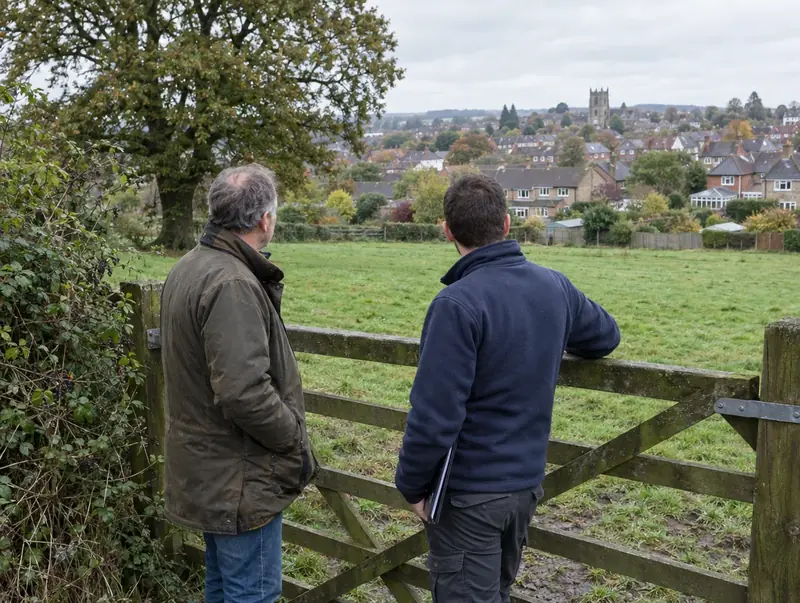 County Armagh
Free site appraisal
Tell us about your land and we will call you back. No cost, no obligation.
Prefer to talk? Call 0800 088 6248.
- Free site appraisalNo cost, no obligation
- Legal fees coveredReasonable fees, on options and promotion
- Nothing to pay upfrontOn promotion: we fund planning
- Direct purchaseSuitable sites, with or without planning
- UK-wideEngland, Wales, Scotland and NI
Our coverage in County Armagh
Our County Armagh coverage takes in 3 towns and cities, centred on Portadown and including Armagh and Lurgan. If your land is near a boundary, we also cover County Down, County Antrim and County Tyrone.
Sites worth a conversation around County Armagh: land behind street frontages, large and long rear gardens and farmland next to the settlement boundary. Because County Armagh is in Northern Ireland, land titles are registered with Land & Property Services (Land Registry and Registry of Deeds) and transfers attract Stamp Duty Land Tax (SDLT).
Tell us where your land is around County Armagh and we will explain the routes open to you.
What we offer in County Armagh
Equalisation between owners
A collaboration or equalisation agreement shares proceeds by area or agreed proportion, so it does not matter whose land ends up as roads, open space or homes in the final layout.
Visibility splays secured
A new junction needs clear sightlines across land on either side. If any of that land is in other ownership, rights or a purchase are needed before the access can work.
One planning strategy
A single application covering the whole area usually produces a better layout than piecemeal schemes, and councils often expect it where their plans call for comprehensive development.
Deals to suit each owner
Different owners may want different routes: some prefer to sell outright, others an option or promotion. The structure can combine these within one plan for the whole area.
Planning and land rules in County Armagh
Permission in Principle, an English route, does not apply in Northern Ireland. Instead, landowners near County Armagh usually seek outline or full planning permission from the council. Developer contributions are agreed under Section 76 of the Planning Act (Northern Ireland) 2011, and there is no Community Infrastructure Levy. Land to Homes can take on that process through an option or promotion agreement, or buy a suitable site directly, subject to survey, title and contract.
In Northern Ireland, new estate roads are usually built under the Private Streets (Northern Ireland) Order 1980, with DfI Roads determining the layout and an agreement and bond securing adoption. Titles are held by Land & Property Services, and some older land is still recorded in the Registry of Deeds. Stamp Duty Land Tax applies to purchases.
| National planning policy | Strategic Planning Policy Statement (SPPS, Edition 2), applied with retained Planning Policy Statements until each council adopts its Plan Strategy |
|---|---|
| Local planning document | Local Development Plan (LDP), made up of a Plan Strategy and a Local Policies Plan |
| Who decides applications | The 11 district councils, with the Department for Infrastructure deciding regionally significant applications |
| In-principle consent | Outline planning permission, with reserved matters approved later |
| Land transaction tax (paid by the buyer) | Stamp Duty Land Tax (SDLT) |
| Land registration | Land & Property Services (Land Registry and Registry of Deeds) |
| How a sale becomes binding | A land sale becomes legally binding when contracts signed by both parties are exchanged and finishes on completion, with the title registered in the Land Registry at Land & Property Services. |
| Developer contributions | Section 76 planning agreements under the Planning Act (Northern Ireland) 2011 (there is no Community Infrastructure Levy) |
Questions about Land Assembly and Access in County Armagh
What if my access crosses a public footpath?
A footpath crossing does not usually prevent access, but the design must keep the path safe and usable. If the layout needs the path to move, a formal diversion order is required, which is a separate legal process that members of the public can object to.
What is a visibility splay?
A visibility splay is the area of land either side of a junction that must be kept clear so drivers can see approaching traffic. Its size depends on road speeds and the highway authority's standards. If part of the splay is owned by someone else, the scheme needs their agreement before the access can work.
How do I find out who owns a strip of land?
Registered land can be searched through the land registry for the relevant nation. Unregistered land is harder: old deeds, local knowledge, highway records and neighbours can all help. Where an owner genuinely cannot be found, there are legal options, but they need specialist advice and can add time.
Should neighbours sell their land together or separately?
Together usually produces a stronger planning case and a more efficient layout, especially where one access can serve everyone. It needs trust and clear documents. Selling separately can work for a plot with its own access, but may limit what the wider area can achieve.
Do you buy land in County Armagh?
Yes. Land to Homes looks at land across County Armagh, including Lurgan, Portadown and Armagh. Every enquiry starts with a free site appraisal, and on option and promotion agreements we pay your reasonable legal fees.
Read more: Land Assembly and Access · Guide: Ransom strips and access: what landowners need to know