
Architecture and Masterplanning in County Down
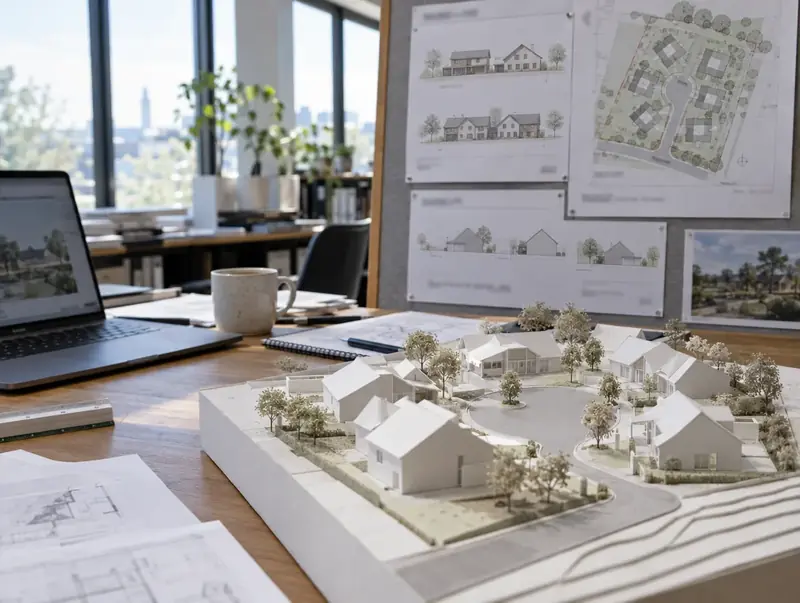
Land to Homes designs residential schemes in County Down from first sketch to planning drawings. For a single infill plot that might mean one carefully placed house; for a larger field, a phased masterplan with roads, open space and a mix of homes for sale, rent and affordable tenures. Good design is often what makes a council comfortable saying yes.
 County Down
Free site appraisal
Tell us about your land and we will call you back. No cost, no obligation.
Prefer to talk? Call 0800 088 6248.
- Free site appraisalNo cost, no obligation
- Legal fees coveredReasonable fees, on options and promotion
- Nothing to pay upfrontOn promotion: we fund planning
- Direct purchaseSuitable sites, with or without planning
- UK-wideEngland, Wales, Scotland and NI
Sites we take on near County Down
Our County Down coverage takes in 6 towns and cities, centred on Bangor (County Down) and including Castlereagh, Newtownards and Newry. Neighbouring areas we also cover include County Antrim, County Armagh and County Tyrone.
Typical work around County Down: land where self-build plots could suit the market, in-principle consents that still need detailed approval and plots where access or drainage is the sticking point. Because County Down is in Northern Ireland, land titles are registered with Land & Property Services (Land Registry and Registry of Deeds) and transfers attract Stamp Duty Land Tax (SDLT).
Send us the site address near County Down and we will tell you what we think the planning route is.
What we offer in County Down
Design codes followed
Where a council has adopted a design code or design guide, we design to it and explain in the design statement how the scheme responds.
House types that suit the place
Homes designed to reflect local materials, scale and character, with layouts people want to live in, rather than a standard pattern book dropped onto the site.
Buildability checked
We test every scheme for construction cost and practicality, so the consent we seek is for homes that can actually be built and then sold or let.
Drainage and ecology built in
Sustainable drainage, biodiversity and tree retention shape the layout from the first sketch, rather than being squeezed in after the homes are placed.
Planning and land rules in County Down
In Northern Ireland, planning applications for new homes around County Down are decided by the local district council, one of 11, while the Department for Infrastructure decides regionally significant schemes. Councils apply the Strategic Planning Policy Statement and their Local Development Plan, together with retained planning policy statements until their Plan Strategy is adopted. Land to Homes offers a free site appraisal and can buy suitable land directly or promote it through planning.
In Northern Ireland, design is assessed under the Strategic Planning Policy Statement and the council's local development plan, with Creating Places, the regional guide to residential layout, still widely used. Building regulations approval is handled by council building control, and new roads usually need to meet Department for Infrastructure standards for adoption.
| National planning policy | Strategic Planning Policy Statement (SPPS, Edition 2), applied with retained Planning Policy Statements until each council adopts its Plan Strategy |
|---|---|
| Local planning document | Local Development Plan (LDP), made up of a Plan Strategy and a Local Policies Plan |
| Who decides applications | The 11 district councils, with the Department for Infrastructure deciding regionally significant applications |
| In-principle consent | Outline planning permission, with reserved matters approved later |
| Land transaction tax (paid by the buyer) | Stamp Duty Land Tax (SDLT) |
| Land registration | Land & Property Services (Land Registry and Registry of Deeds) |
| How a sale becomes binding | A land sale becomes legally binding when contracts signed by both parties are exchanged and finishes on completion, with the title registered in the Land Registry at Land & Property Services. |
| Developer contributions | Section 76 planning agreements under the Planning Act (Northern Ireland) 2011 (there is no Community Infrastructure Levy) |
Your questions answered for County Down
Do new housing schemes need sustainable drainage?
In most cases, yes. National and local policy usually expects new developments to manage rainwater sustainably, for example with swales, ponds and permeable paving. In Wales, most new developments need separate approval from the local SuDS approving body. We design drainage into the layout from the start, because it can take up a real share of the site.
What is a design and access statement?
It is a short report submitted with certain planning applications that explains the design principles behind a scheme and how people will get to and move around it. In England and Wales it is usually needed for major development and for some smaller schemes in sensitive areas. Scotland and Northern Ireland set their own requirements for design statements.
How do you make new homes fit in with existing streets?
We study the scale, materials, building lines and spaces of the surrounding area and design homes and streets that respond to them. On a village edge that might mean lower density and more landscaping; in a town, homes that follow the existing street pattern. Early talks with planning officers and neighbours help shape the design.
How many homes could my land take?
It depends on the size and shape of the site, the access, the character of the area, the open space and drainage the scheme needs, and local planning policy on density. Sites of the same size can have very different capacities. A capacity study is the reliable way to answer the question, and our free site appraisal gives an indicative figure.
Do you take on planning and building work in County Down?
Yes, on sites we buy, option, promote or develop in partnership across County Down, including Castlereagh, Bangor (County Down) and Banbridge. We do not take on planning or building work for third parties as a consultancy.
Read more: Architecture and Masterplanning · Guide: Planning permission explained for landowners