
Architecture and Masterplanning in County Fermanagh
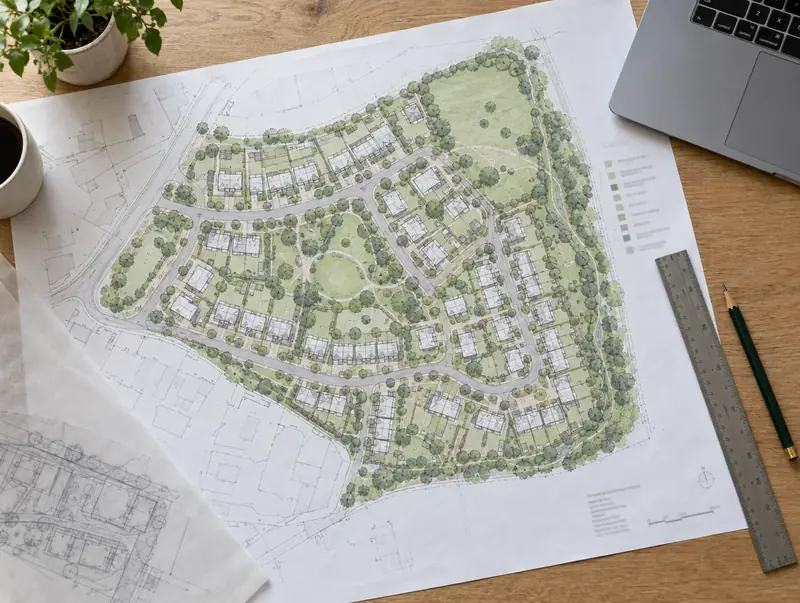
Architecture and masterplanning in County Fermanagh is the design work that turns a parcel of land into a layout of homes, streets and open space that a council can approve and a builder can deliver. Land to Homes prepares capacity studies, site layouts, house types and design statements, testing each one against planning policy, access, drainage and the character of the area.
 County Fermanagh
Free site appraisal
Tell us about your land and we will call you back. No cost, no obligation.
Prefer to talk? Call 0800 088 6248.
- Free site appraisalNo cost, no obligation
- Legal fees coveredReasonable fees, on options and promotion
- Nothing to pay upfrontOn promotion: we fund planning
- Direct purchaseSuitable sites, with or without planning
- UK-wideEngland, Wales, Scotland and NI
Our work around County Fermanagh
We cover 2 places across County Fermanagh: Enniskillen is the main one, alongside Lisnaskea. Neighbouring areas we also cover include County Tyrone, County Armagh and County Londonderry.
Projects we can take on around County Fermanagh include sites that need a fresh planning strategy, in-principle consents that still need detailed approval and plots where access or drainage is the sticking point. Planning in County Fermanagh follows Northern Ireland’s rules: the Strategic Planning Policy Statement sets national policy and the council’s Local Development Plan sets local policy.
If you have a site near County Fermanagh that is stuck, a short call is the best place to start.
How we work in County Fermanagh
Clear plans for landowners
We explain drawings in plain terms, so you can see how your land would be used, where the access runs and what land might be left over.
Masterplans for larger sites
Streets, open space, landscaping, play areas and phasing set out in one coherent plan, with room for homes for sale, rent and affordable tenures.
Drainage and ecology built in
Sustainable drainage, biodiversity and tree retention shape the layout from the first sketch, rather than being squeezed in after the homes are placed.
Funded on promotion
Where we promote your land, the design work is part of the planning work we fund, recovered from the sale proceeds only if the land sells with planning.
Rules that apply in County Fermanagh
Countryside planning policy in Northern Ireland is generally restrictive, so land inside or next to the settlement development limits around County Fermanagh is usually the strongest prospect for new homes. Outline planning permission can establish the principle, with reserved matters approved later. A promotion agreement lets us fund that planning work, with our costs recovered from the sale proceeds only if the land sells with planning. Your reasonable legal fees are covered too, agreed in the heads of terms.
In Northern Ireland, design is assessed under the Strategic Planning Policy Statement and the council's local development plan, with Creating Places, the regional guide to residential layout, still widely used. Building regulations approval is handled by council building control, and new roads usually need to meet Department for Infrastructure standards for adoption.
| National planning policy | Strategic Planning Policy Statement (SPPS, Edition 2), applied with retained Planning Policy Statements until each council adopts its Plan Strategy |
|---|---|
| Local planning document | Local Development Plan (LDP), made up of a Plan Strategy and a Local Policies Plan |
| Who decides applications | The 11 district councils, with the Department for Infrastructure deciding regionally significant applications |
| In-principle consent | Outline planning permission, with reserved matters approved later |
| Land transaction tax (paid by the buyer) | Stamp Duty Land Tax (SDLT) |
| Land registration | Land & Property Services (Land Registry and Registry of Deeds) |
| How a sale becomes binding | A land sale becomes legally binding when contracts signed by both parties are exchanged and finishes on completion, with the title registered in the Land Registry at Land & Property Services. |
| Developer contributions | Section 76 planning agreements under the Planning Act (Northern Ireland) 2011 (there is no Community Infrastructure Levy) |
Your questions answered for County Fermanagh
Do I need an architect for a planning application?
Not by law, but a well-designed scheme with clear drawings stands a much better chance. Larger schemes also need specialist input from landscape architects, highways engineers, drainage engineers and ecologists. Where Land to Homes promotes land, we appoint and fund the design team as part of the planning work, so the landowner does not need to.
How many homes could my land take?
It depends on the size and shape of the site, the access, the character of the area, the open space and drainage the scheme needs, and local planning policy on density. Sites of the same size can have very different capacities. A capacity study is the reliable way to answer the question, and our free site appraisal gives an indicative figure.
What is a masterplan?
A masterplan is a drawing and supporting document that shows how a larger site will be laid out: where the homes, roads, footpaths, open space and drainage go, and how the site will be built in phases. It gives the council and the community a clear picture of the scheme before detailed designs are prepared for each phase.
What is a design and access statement?
It is a short report submitted with certain planning applications that explains the design principles behind a scheme and how people will get to and move around it. In England and Wales it is usually needed for major development and for some smaller schemes in sensitive areas. Scotland and Northern Ireland set their own requirements for design statements.
Can you manage a site in County Fermanagh from planning to build?
On land we take forward ourselves across County Fermanagh, including Lisnaskea and Enniskillen, we manage planning, design and construction. Tell us about the site and we will explain how we would approach it.
Read more: Architecture and Masterplanning · Guide: Planning permission explained for landowners