
Serviced Plots for Self-Build in Staffordshire
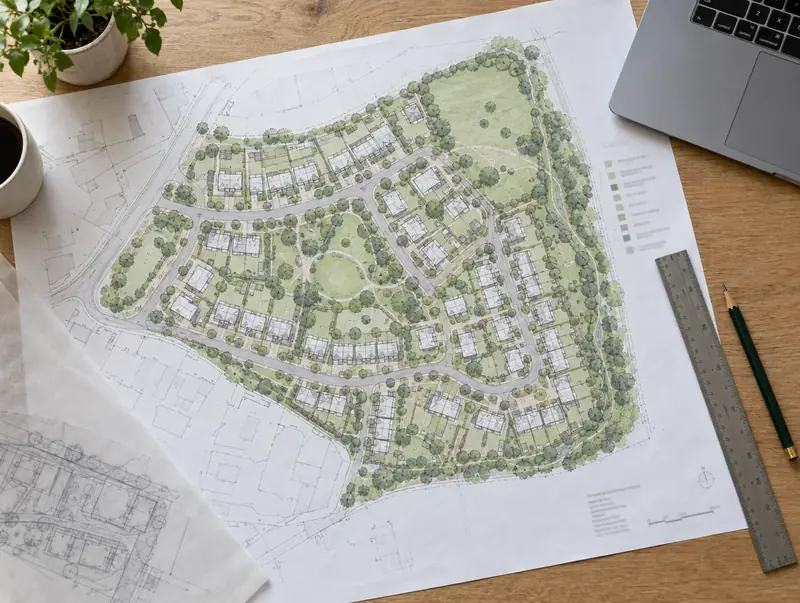
A serviced plot in Staffordshire is a parcel of land with planning permission or a clear route to it, a road access and connections for water, drainage and electricity at the boundary, ready for someone to build their own home. Land to Homes looks for land that suits serviced plots, takes it through planning and services it, so self-builders can focus on the house.
 Staffordshire
Free site appraisal
Tell us about your land and we will call you back. No cost, no obligation.
Prefer to talk? Call 0800 088 6248.
- Free site appraisalNo cost, no obligation
- Legal fees coveredReasonable fees, on options and promotion
- Nothing to pay upfrontOn promotion: we fund planning
- Direct purchaseSuitable sites, with or without planning
- UK-wideEngland, Wales, Scotland and NI
Sites we take on near Staffordshire
We cover 11 places across Staffordshire: Stoke-on-Trent is the main one, alongside Longton, Stafford and Newcastle under Lyme. Next door, we also cover West Midlands, Derbyshire and Shropshire. Our Great Barr head office in Birmingham is about 19 miles from the middle of Staffordshire.
Projects we can take on around Staffordshire include fields that need a masterplan before an application, plots where access or drainage is the sticking point and in-principle consents that still need detailed approval. In England, where Staffordshire sits, planning decisions are made by the local planning authority, usually the district, borough, city or unitary council (or a national park authority).
Send us the site address near Staffordshire and we will tell you what we think the planning route is.
How we work in Staffordshire
Landowners welcome
If your land could suit self-build plots, our free site appraisal explains the options, including a direct purchase, an option or a promotion agreement.
Self-build or custom build
Build the home yourself with your own builder and architect, or choose a more complete custom build package where one is offered on the site.
Services at the boundary
Plots are planned with road access and connections for water, drainage and electricity, so you are not left negotiating with utility companies on your own.
Right to Build explained
In England, councils keep self-build and custom housebuilding registers. We explain how the registers work in general terms, but they are run by councils, not by us.
Planning and land rules in Staffordshire
Selling development land in Staffordshire usually starts with heads of terms, a short written summary of price, conditions and fees, before solicitors draft the contract. In England the sale becomes binding on exchange of contracts and finishes on completion, with the title then registered at HM Land Registry. The buyer normally pays Stamp Duty Land Tax. On option and promotion agreements with Land to Homes, your reasonable legal fees are covered, with the amount agreed in the heads of terms.
In England, councils keep self-build and custom housebuilding registers under the Right to Build legislation and have a duty to grant enough suitable permissions for serviced plots to meet demand. Self-build homes can usually claim an exemption from the Community Infrastructure Levy where it is charged, and plots are judged against the National Planning Policy Framework and the Local Plan.
| National planning policy | National Planning Policy Framework (NPPF), revised August 2026, with national planning practice guidance |
|---|---|
| Local planning document | Local Plan |
| Who decides applications | The local planning authority, usually the district, borough, city or unitary council (or a national park authority) |
| In-principle consent | Outline planning permission, with reserved matters approved later |
| Land transaction tax (paid by the buyer) | Stamp Duty Land Tax (SDLT) |
| Land registration | HM Land Registry |
| How a sale becomes binding | A land sale becomes legally binding on exchange of contracts and finishes on completion, after which the buyer registers the title with HM Land Registry. |
| Developer contributions | Section 106 planning obligations, plus the Community Infrastructure Levy (CIL) where the council charges it |
Your questions answered for Staffordshire
Can I get a mortgage for a self-build plot?
Many lenders offer self-build mortgages that release money in stages as the build progresses, but criteria vary and a standard mortgage will not usually work. You will normally need planning permission, a detailed budget and a warranty or professional supervision in place. A mortgage broker or adviser can explain the options; we cannot give financial advice.
What is a serviced plot?
A serviced plot is a piece of land ready for a single home, with access to a road and connections for services such as water, drainage and electricity at or near the boundary. In England, the Right to Build legislation defines a serviced plot by reference to access to a public highway and those utility connections, or the ability to provide them.
Do self-builders pay the Community Infrastructure Levy?
In England and Wales, where a council charges the Community Infrastructure Levy, self-builders can usually claim an exemption, but it must be applied for correctly and before work starts, and the conditions followed afterwards. Mistakes can mean the full charge becomes payable. Scotland and Northern Ireland do not have the levy. Take advice before starting work.
What is the Right to Build register?
In England, councils must keep a register of people and groups who want a serviced plot to build their own home, and have a duty to grant enough suitable planning permissions to meet the demand it shows. Many councils let you join free, though some charge a fee or apply local connection tests. The duty applies in England only.
Do you take on planning and building work in Staffordshire?
Yes, on sites we buy, option, promote or develop in partnership across Staffordshire, including Stafford, Stoke-on-Trent and Cannock. We do not take on planning or building work for third parties as a consultancy.
Read more: Serviced Plots for Self-Build · Guide: Ransom strips and access: what landowners need to know