
Serviced Plots for Self-Build in Gloucestershire
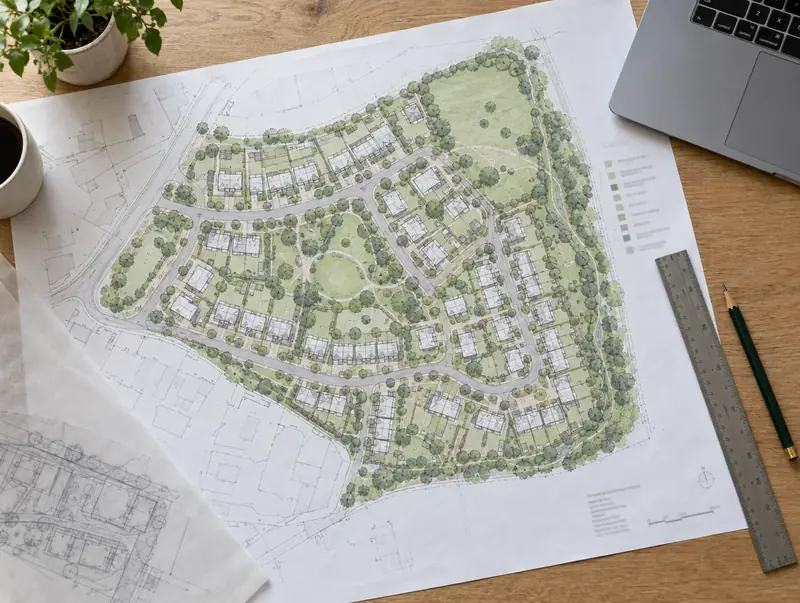
Land to Homes brings forward serviced plots as well as finished homes, and Gloucestershire is one of the areas where self-builders can register interest. On larger sites, a share of plots can be set aside for self-build and custom build, each with access, services and a plot passport setting out what can be built. Landowners with land suited to plots can also talk to us.
 Gloucestershire
Free site appraisal
Tell us about your land and we will call you back. No cost, no obligation.
Prefer to talk? Call 0800 088 6248.
- Free site appraisalNo cost, no obligation
- Legal fees coveredReasonable fees, on options and promotion
- Nothing to pay upfrontOn promotion: we fund planning
- Direct purchaseSuitable sites, with or without planning
- UK-wideEngland, Wales, Scotland and NI
Sites we take on near Gloucestershire
Our Gloucestershire coverage takes in 8 towns and cities, centred on Gloucester and including Mangotsfield, Cirencester and Cheltenham. Next door, we also cover Bristol, Wiltshire and Herefordshire. Our Great Barr head office in Birmingham is about 60 miles from the middle of Gloucestershire.
Typical work around Gloucestershire: fields that need a masterplan before an application, sites where the layout needs to change and plots where access or drainage is the sticking point. As Gloucestershire is in England, applications are judged against the National Planning Policy Framework, and the buyer of land pays Stamp Duty Land Tax (SDLT).
Tell us about the site near Gloucestershire and we will explain how we would take it forward.
What you get in Gloucestershire
Part of larger schemes
On bigger developments, serviced plots can sit alongside homes for sale, rent and affordable tenures, sharing the same roads and services.
Landowners welcome
If your land could suit self-build plots, our free site appraisal explains the options, including a direct purchase, an option or a promotion agreement.
Planning made clear
We aim to bring plots forward with planning permission in place, or with a clear set of rules, often called a plot passport, describing what can be built.
Design rules up front
Where a site has a design code or plot passport, we set out the rules before you commit, so you know what the planning permission allows.
The English system, as it applies in Gloucestershire
Selling development land in Gloucestershire usually starts with heads of terms, a short written summary of price, conditions and fees, before solicitors draft the contract. In England the sale becomes binding on exchange of contracts and finishes on completion, with the title then registered at HM Land Registry. The buyer normally pays Stamp Duty Land Tax. On option and promotion agreements with Land to Homes, your reasonable legal fees are covered, with the amount agreed in the heads of terms.
In England, councils keep self-build and custom housebuilding registers under the Right to Build legislation and have a duty to grant enough suitable permissions for serviced plots to meet demand. Self-build homes can usually claim an exemption from the Community Infrastructure Levy where it is charged, and plots are judged against the National Planning Policy Framework and the Local Plan.
| National planning policy | National Planning Policy Framework (NPPF), revised August 2026, with national planning practice guidance |
|---|---|
| Local planning document | Local Plan |
| Who decides applications | The local planning authority, usually the district, borough, city or unitary council (or a national park authority) |
| In-principle consent | Outline planning permission, with reserved matters approved later |
| Land transaction tax (paid by the buyer) | Stamp Duty Land Tax (SDLT) |
| Land registration | HM Land Registry |
| How a sale becomes binding | A land sale becomes legally binding on exchange of contracts and finishes on completion, after which the buyer registers the title with HM Land Registry. |
| Developer contributions | Section 106 planning obligations, plus the Community Infrastructure Levy (CIL) where the council charges it |
Common questions in Gloucestershire
Can I sell part of my land as self-build plots?
Yes, if the land has planning prospects and suitable access. A few plots can suit land on a village edge or a large garden. Our free site appraisal looks at whether plots would work and whether a direct sale to us, an option or a promotion agreement is the right route. On option and promotion agreements we pay your reasonable legal fees.
What is the difference between self-build and custom build?
With self-build, you organise the design and construction of your home yourself, either doing some of the work or hiring a builder. With custom build, a developer provides more of the package, such as a serviced plot, a range of designs and sometimes the construction itself, while you make the key choices. The line between the two is not always sharp.
Is there a self-build register in Scotland, Wales or Northern Ireland?
In Scotland, planning authorities keep self-build lists of people interested in building their own home, which inform local planning. Wales and Northern Ireland do not have a statutory register like England's, although some councils may still record interest, and self-build plots are assessed through normal planning policy. Check with your local council.
Do self-builders pay the Community Infrastructure Levy?
In England and Wales, where a council charges the Community Infrastructure Levy, self-builders can usually claim an exemption, but it must be applied for correctly and before work starts, and the conditions followed afterwards. Mistakes can mean the full charge becomes payable. Scotland and Northern Ireland do not have the levy. Take advice before starting work.
Can you manage a site in Gloucestershire from planning to build?
On land we take forward ourselves across Gloucestershire, including Kingswood, Gloucester and Yate, we manage planning, design and construction. Tell us about the site and we will explain how we would approach it.
Read more: Serviced Plots for Self-Build · Guide: Selling part of your garden: what you need to know