
Planning Permission and Strategy in Derry/Londonderry
Land to Homes runs the planning process for residential sites in Derry/Londonderry, from a first look at policy to a decision notice. We build the consultant team, commission the surveys, talk to the council and the community, and prepare the application. Where we promote land, we fund the planning work, and those costs are recovered from the sale proceeds only if the land sells with planning.
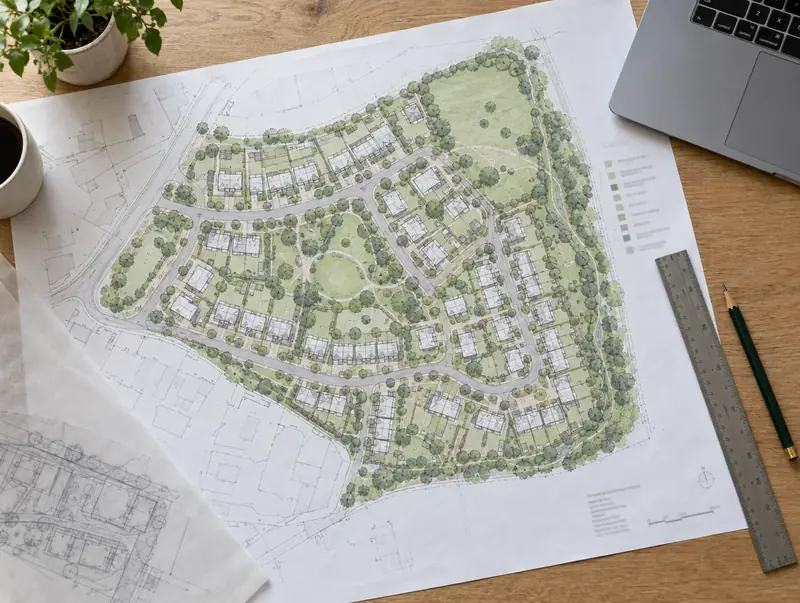 Derry/Londonderry · BT48
Free site appraisal
Tell us about your land and we will call you back. No cost, no obligation.
Prefer to talk? Call 0800 088 6248.
- Free site appraisalNo cost, no obligation
- Legal fees coveredReasonable fees, on options and promotion
- Nothing to pay upfrontOn promotion: we fund planning
- Direct purchaseSuitable sites, with or without planning
- UK-wideEngland, Wales, Scotland and NI
Our work around Derry/Londonderry
Derry/Londonderry is the main town we cover in County Londonderry, centred on postcode district BT48. The nearest other places we cover are Strabane (13 miles), Limavady (15 miles) and Coleraine (27 miles).
Near Derry/Londonderry, we look at plots where access or drainage is the sticking point, in-principle consents that still need detailed approval and land where self-build plots could suit the market. Because Derry/Londonderry is in Northern Ireland, land titles are registered with Land & Property Services (Land Registry and Registry of Deeds) and transfers attract Stamp Duty Land Tax (SDLT).
Send us the site address near Derry/Londonderry and we will tell you what we think the planning route is.
How we work in Derry/Londonderry
Your legal fees covered
On option and promotion agreements we pay your reasonable legal fees, with the amount agreed in the heads of terms before you instruct a solicitor.
Nothing to pay upfront
Where we promote land, we fund the planning work. They are only recovered from the sale proceeds if the land sells with planning permission.
The right application route
Outline, full or another route the rules allow in that nation. We explain why we chose it and what each route means for timing, cost and risk.
Honest about risk
No one can guarantee planning permission. We tell you plainly where the risks sit, what could be done about them and when a site is unlikely to succeed.
The Northern Irish system, as it applies in Derry/Londonderry
Selling land near Derry/Londonderry follows a familiar pattern in Northern Ireland: heads of terms, then an exchange of contracts signed by both sides, which makes the sale binding, and completion. The buyer pays Stamp Duty Land Tax, as in England, and the title is registered with Land Registry, part of Land & Property Services, although older titles may first need moving from the Registry of Deeds. Infrastructure and affordable housing are usually secured through a Section 76 planning agreement.
In Northern Ireland, the 11 district councils decide most applications under the Strategic Planning Policy Statement and their local development plans, while regionally significant applications go to the Department for Infrastructure. Major applications need pre-application community consultation, and planning agreements are made under Section 76. Countryside policy is restrictive, so settlement limits matter.
| National planning policy | Strategic Planning Policy Statement (SPPS, Edition 2), applied with retained Planning Policy Statements until each council adopts its Plan Strategy |
|---|---|
| Land registration | Land & Property Services (Land Registry and Registry of Deeds) |
| How a sale becomes binding | A land sale becomes legally binding when contracts signed by both parties are exchanged and finishes on completion, with the title registered in the Land Registry at Land & Property Services. |
| Developer contributions | Section 76 planning agreements under the Planning Act (Northern Ireland) 2011 (there is no Community Infrastructure Levy) |
Your questions answered for Derry/Londonderry
What is the difference between outline and full planning permission?
Outline permission establishes whether development is acceptable in principle, with some or all of the details, known as reserved matters, left for a later application. Full permission approves the detailed scheme in one go. Outline is often used to secure the principle on land before it is sold. In Scotland the equivalent of outline is planning permission in principle.
How long does it take to get planning permission?
It varies with the size of the scheme, the council's workload and whether a legal agreement is needed. Small schemes usually move faster than major applications, which have longer statutory periods and often need a planning obligation. Pre-application advice and good survey work add time at the start but often save time later. We give you a realistic view for your site.
What is a Section 106 agreement?
A Section 106 agreement is a legal agreement between a council and a landowner or developer that makes a development acceptable in planning terms, for example by securing affordable homes or contributions to schools and roads. It applies in England and Wales. Scotland uses Section 75 agreements and Northern Ireland uses Section 76 planning agreements for similar purposes.
Who pays for a planning application?
Normally whoever makes the application pays the council fee and the cost of the surveys and reports. Under a promotion agreement with Land to Homes, we fund the planning work, and those costs are only recovered from the sale proceeds if the land sells with planning permission. On a direct purchase without planning, the planning cost and risk become ours.
Do you take on planning and building work in Derry/Londonderry?
Yes, on sites we buy, option, promote or develop in partnership in Derry/Londonderry and elsewhere in County Londonderry, including Magherafelt, Limavady and Coleraine. We do not take on planning or building work for third parties as a consultancy.
Read more: Planning Permission and Strategy · Guide: Biodiversity net gain for landowners: what it means for your land