
New Home Construction in Exeter
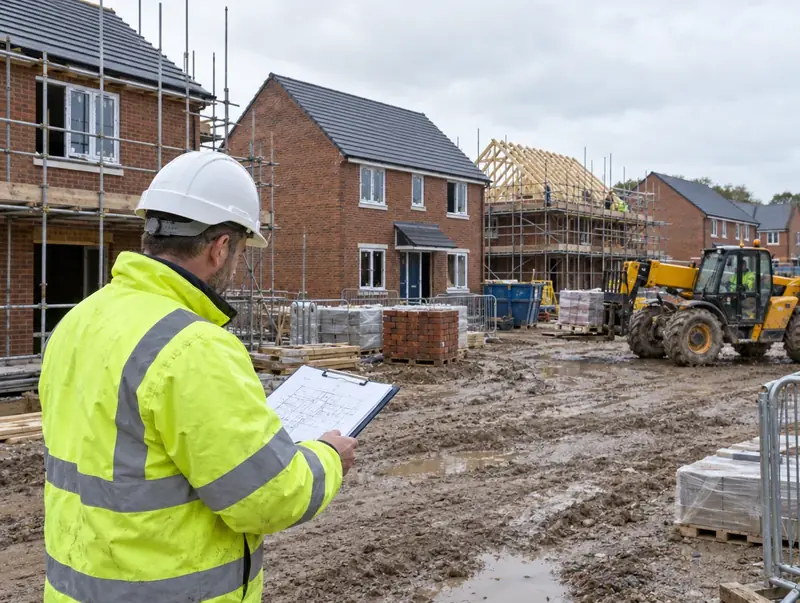
Once a site in Exeter has planning permission and the pre-commencement conditions are cleared, building can start. We organise the groundworks, utilities and roads first, then build the homes in phases, with building control inspections at key stages. Every home is built to the building regulations or building standards that apply in the nation where the site sits.
 Exeter · EX2
Free site appraisal
Tell us about your land and we will call you back. No cost, no obligation.
Prefer to talk? Call 0800 088 6248.
- Free site appraisalNo cost, no obligation
- Legal fees coveredReasonable fees, on options and promotion
- Nothing to pay upfrontOn promotion: we fund planning
- Direct purchaseSuitable sites, with or without planning
- UK-wideEngland, Wales, Scotland and NI
Our work around Exeter
Exeter sits about 36 miles north-east of Plymouth in Devon, in the EX2 postcode district. The nearest other places we cover are Exmouth (9 miles), Tiverton (12 miles) and Newton Abbot (14 miles). Within England, Exeter falls in the South West region.
Projects we can take on around Exeter include fields that need a masterplan before an application, sites where the layout needs to change and schemes that need redesigning to work. Because Exeter is in England, land titles are registered with HM Land Registry and transfers attract Stamp Duty Land Tax (SDLT).
If you have a site near Exeter that is stuck, a short call is the best place to start.
What you get in Exeter
Respect for neighbours
Site traffic, working hours, noise and dust are managed under a construction management plan where the council requires one, and neighbours know who to contact.
Warranty considered early
Most mortgage lenders expect a new home to carry a recognised structural warranty, so warranty provider requirements are considered from the design stage.
Built to the right regulations
Each home is built to the building regulations or building standards of its nation, with inspections at key stages of the build.
Conditions cleared first
Pre-commencement conditions, legal agreements and utility connections are dealt with before work begins, so the build starts on a sound footing.
How the rules work in Exeter
Whether a field or large garden could take homes depends mostly on the council's Local Plan and national policy. Under the National Planning Policy Framework, plans define settlement boundaries, and land just outside Exeter may still come forward if it is allocated, previously developed or meets evidenced unmet housing need. Smaller housing schemes can also use Permission in Principle, an England-only route that settles location, use and amount first. Our free appraisal explains which route suits your land.
In England, homes are built to the Building Regulations and signed off by council building control or a registered building control approver. Higher-risk residential buildings go through the Building Safety Regulator. Energy standards are being raised through the Future Homes Standard, and most developments must also deliver the biodiversity net gain agreed at planning.
| National planning policy | National Planning Policy Framework (NPPF), revised August 2026, with national planning practice guidance |
|---|---|
| Land transaction tax (paid by the buyer) | Stamp Duty Land Tax (SDLT) |
| Land registration | HM Land Registry |
| How a sale becomes binding | A land sale becomes legally binding on exchange of contracts and finishes on completion, after which the buyer registers the title with HM Land Registry. |
Common questions in Exeter
Do new homes have to be energy efficient?
Yes. Each nation's building regulations or building standards set energy efficiency requirements for new homes, and these have been tightened over recent years. In Scotland, new homes generally need zero direct emissions heating, such as heat pumps. England and Wales are moving to higher standards through updates to their own regulations.
What are building regulations?
Building regulations set minimum standards for the design and construction of buildings, including structure, fire safety, energy efficiency, drainage and accessibility. England, Wales and Northern Ireland each have their own regulations, approved through building control. Scotland has building standards, and work needs a building warrant from the council before it starts and a completion certificate at the end.
What is a new-build warranty?
A new-build warranty is an insurance-backed policy that covers certain defects in a newly built home for a set period after completion. In the early part of the cover the builder is usually responsible for putting defects right, with the warranty provider covering major structural problems later on. Most mortgage lenders require a recognised warranty or a professional consultant's certificate.
What happens to the roads and sewers on a new development?
On many developments the new roads are built to the highway authority's standards and then adopted, so the council maintains them. Sewers can similarly be adopted by the water company. Where roads or open spaces are not adopted, they are usually looked after by a management company funded by residents, and buyers should check this before reserving.
Do you take on planning and building work in Exeter?
Yes, on sites we buy, option, promote or develop in partnership in Exeter and elsewhere in Devon, including Newton Abbot, Torquay and Bideford. We do not take on planning or building work for third parties as a consultancy.
Read more: New Home Construction · Guide: Buying a new-build home: what to expect from reservation to keys