
New Home Construction in Bristol
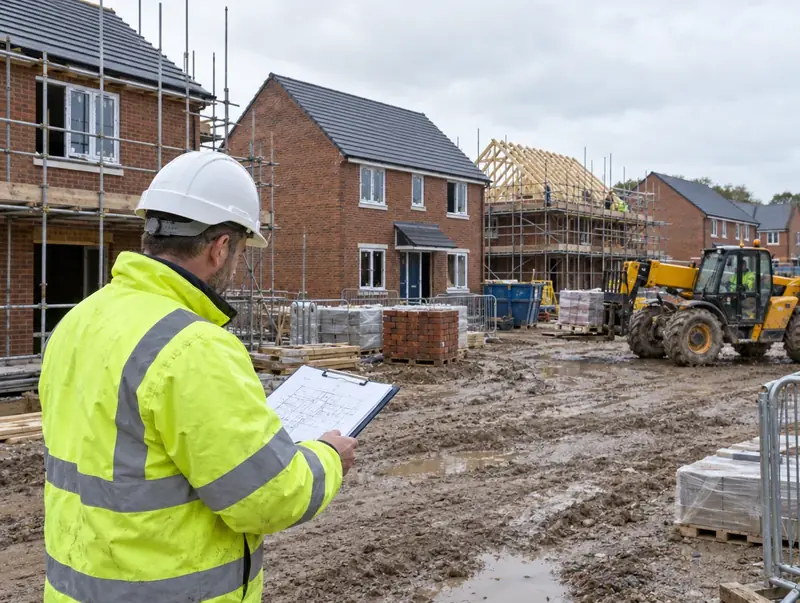
Once a site in Bristol has planning permission and the pre-commencement conditions are cleared, building can start. We organise the groundworks, utilities and roads first, then build the homes in phases, with building control inspections at key stages. Every home is built to the building regulations or building standards that apply in the nation where the site sits.
 Bristol
Free site appraisal
Tell us about your land and we will call you back. No cost, no obligation.
Prefer to talk? Call 0800 088 6248.
- Free site appraisalNo cost, no obligation
- Legal fees coveredReasonable fees, on options and promotion
- Nothing to pay upfrontOn promotion: we fund planning
- Direct purchaseSuitable sites, with or without planning
- UK-wideEngland, Wales, Scotland and NI
Planning and building around Bristol
In Bristol, our coverage is centred on Bristol, and we look at land across the whole area. If your land is near a boundary, we also cover Somerset, Gloucestershire and Wiltshire.
Near Bristol, we look at plots where access or drainage is the sticking point, land where self-build plots could suit the market and land with an expired or ageing consent. As Bristol is in England, applications are judged against the National Planning Policy Framework, and the buyer of land pays Stamp Duty Land Tax (SDLT).
Tell us about the site near Bristol and we will explain how we would take it forward.
What you get in Bristol
Mixed tenures on one site
Homes for sale, homes for rent and affordable homes can be built together, designed so that the tenures are hard to tell apart from the street.
Built to the right regulations
Each home is built to the building regulations or building standards of its nation, with inspections at key stages of the build.
Conditions cleared first
Pre-commencement conditions, legal agreements and utility connections are dealt with before work begins, so the build starts on a sound footing.
Respect for neighbours
Site traffic, working hours, noise and dust are managed under a construction management plan where the council requires one, and neighbours know who to contact.
Rules that apply in Bristol
If your land near Bristol lies in the Green Belt, national policy still protects it, but England's planning framework now recognises grey belt: Green Belt land that is previously developed or does not strongly contribute to certain Green Belt purposes. Where there is evidenced unmet need and the location is sustainable, grey belt housing can be acceptable, with major schemes meeting the Golden Rules on affordable housing, infrastructure and green space. Planning is never guaranteed, so we check policy, access and constraints first.
In England, homes are built to the Building Regulations and signed off by council building control or a registered building control approver. Higher-risk residential buildings go through the Building Safety Regulator. Energy standards are being raised through the Future Homes Standard, and most developments must also deliver the biodiversity net gain agreed at planning.
| National planning policy | National Planning Policy Framework (NPPF), revised August 2026, with national planning practice guidance |
|---|---|
| Local planning document | Local Plan |
| Who decides applications | The local planning authority, usually the district, borough, city or unitary council (or a national park authority) |
| In-principle consent | Outline planning permission, with reserved matters approved later |
| Land transaction tax (paid by the buyer) | Stamp Duty Land Tax (SDLT) |
| Land registration | HM Land Registry |
| How a sale becomes binding | A land sale becomes legally binding on exchange of contracts and finishes on completion, after which the buyer registers the title with HM Land Registry. |
| Developer contributions | Section 106 planning obligations, plus the Community Infrastructure Levy (CIL) where the council charges it |
Your questions answered for Bristol
Do new homes have to be energy efficient?
Yes. Each nation's building regulations or building standards set energy efficiency requirements for new homes, and these have been tightened over recent years. In Scotland, new homes generally need zero direct emissions heating, such as heat pumps. England and Wales are moving to higher standards through updates to their own regulations.
Does Land to Homes build the homes itself?
Land to Homes manages planning, design and construction on the sites it brings forward, and is part of the S&K Group, a construction and property group. Construction is carried out with contractors and suppliers under our management. Because we plan land with building in mind, the schemes we take to planning are designed to be delivered.
What are building regulations?
Building regulations set minimum standards for the design and construction of buildings, including structure, fire safety, energy efficiency, drainage and accessibility. England, Wales and Northern Ireland each have their own regulations, approved through building control. Scotland has building standards, and work needs a building warrant from the council before it starts and a completion certificate at the end.
How are neighbours affected during construction?
Building work brings deliveries, noise and some disruption. Councils often require a construction management plan setting out working hours, delivery routes, parking and controls on dust and noise. We follow those requirements, keep the site tidy and secure, and make sure neighbours know who to contact if something goes wrong.
Do you take on planning and building work in Bristol?
Yes, on sites we buy, option, promote or develop in partnership across Bristol, including Kingswood, Mangotsfield and Nailsea. We do not take on planning or building work for third parties as a consultancy.
Read more: New Home Construction · Guide: Buying a new-build home: what to expect from reservation to keys