
Sell Land Without Planning in Clydebank
Most development land in Clydebank starts life with no planning at all. If your field, yard or paddock sits close to existing homes, you have a choice: take a lower price now and pass the risk to a buyer, or wait for planning and share in the higher value. We set out both sides in writing after a free appraisal.
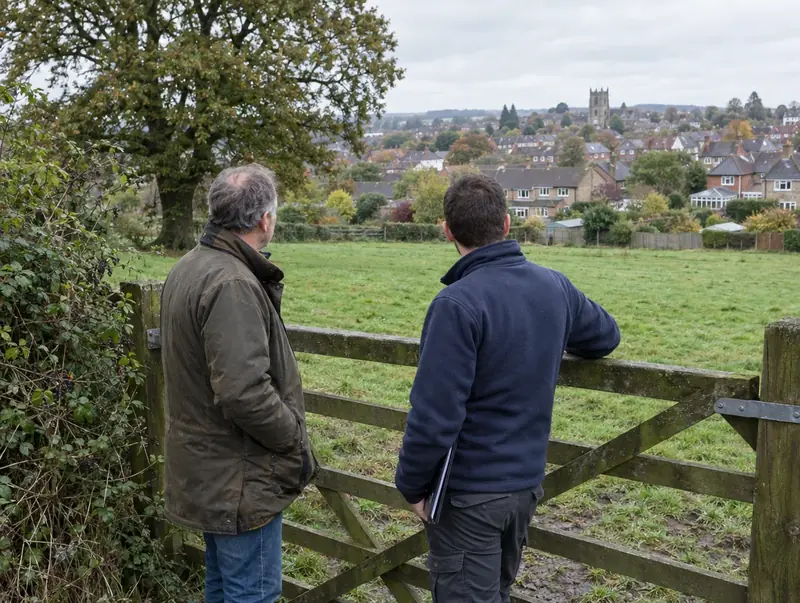 Clydebank · G81
Free site appraisal
Tell us about your land and we will call you back. No cost, no obligation.
Prefer to talk? Call 0800 088 6248.
- Free site appraisalNo cost, no obligation
- Legal fees coveredReasonable fees, on options and promotion
- Nothing to pay upfrontOn promotion: we fund planning
- Direct purchaseSuitable sites, with or without planning
- UK-wideEngland, Wales, Scotland and NI
Land and sites near Clydebank
Clydebank sits about 6 miles north-west of Glasgow in Glasgow & the Clyde, in the G81 postcode district. Close by, our coverage also takes in Renfrew, Bearsden and Paisley.
Around Clydebank we look at farmland next to the settlement boundary, backland plots with a workable access and land that already has planning permission. Because Clydebank is in Scotland, land titles are registered with Registers of Scotland (Land Register of Scotland) and transfers attract Land and Buildings Transaction Tax (LBTT).
A postcode and a rough boundary are enough for us to start a free appraisal of land near Clydebank.
What you get in Clydebank
Constraints checked first
Flood risk, access, heritage, ecology, protected trees and landscape designations can each decide whether planning is realistic. We look at all of these before discussing any deal or price mechanism with you.
Local plan timing
Councils review their development plans periodically and invite landowners to put sites forward. We check where your council is in that cycle, because it can matter more than any single application.
Hope value explained
Land with no permission but a realistic chance of one is worth more than its current use value, but less than consented land. We explain where your site sits on that scale and why.
Conditional contracts
Contracts are signed now, but the sale only completes if a satisfactory planning permission is granted by a longstop date. The price is usually fixed, or set by an agreed formula, when the contract is signed.
How the rules work in Clydebank
Land sales in Scotland are concluded through missives, an exchange of formal letters between solicitors. Once missives are concluded they form a binding contract, and the buyer takes entry at settlement, then registers the title with Registers of Scotland. For land near Clydebank, missives can be made conditional on planning permission in principle, so the sale only proceeds if consent is secured. The buyer pays Land and Buildings Transaction Tax to Revenue Scotland.
In Scotland, the Local Development Plan and National Planning Framework 4 decide where housing goes. Land is often sold on missives with a suspensive condition that planning permission in principle is granted. Under the newer plan system councils prepare an evidence report before the proposed plan, so landowners benefit from engaging early.
| Who decides applications | The council as planning authority (or a national park authority in its area) |
|---|---|
| Land transaction tax (paid by the buyer) | Land and Buildings Transaction Tax (LBTT) |
| Land registration | Registers of Scotland (Land Register of Scotland) |
| How a sale becomes binding | Land sales are concluded through missives, formal letters exchanged between solicitors that become a binding contract once concluded, followed by settlement on the date of entry and registration in the Land Register of Scotland. |
Your questions answered for Clydebank
Can I keep using the land while planning is pursued?
Usually, yes. Under options and promotion agreements you normally keep ownership and can carry on using the land, for example for grazing or farming, until it is sold. The agreement sets out access for surveys and any restrictions, such as on granting new long-term tenancies.
What is a call for sites?
When a council prepares or reviews its development plan, it usually invites landowners and developers to put land forward for consideration. Submitting your site does not mean it will be allocated, but it puts the land in front of the council's planning team. In Wales this is usually called the candidate site process.
Can I get planning on land outside the settlement boundary?
Sometimes. Land just outside a boundary is usually treated as countryside, where new housing is restricted. Prospects improve if the council allocates the land in a new plan, or where national policy gives weight to unmet housing need. Each nation handles this differently, so we explain the position for your council area.
What is a subject to planning contract?
It is a contract where both sides commit now, but the sale only completes if a satisfactory planning permission is granted. It sets a longstop date, defines what counts as satisfactory and usually says who controls the application. If permission is not granted by the longstop date, either side can normally withdraw without penalty.
Is Clydebank an area you cover for land?
Yes, we cover land in Clydebank and elsewhere in Glasgow & the Clyde, including Bishopbriggs, Glasgow and Greenock. Where a site suits us we can buy it directly, or set up an option or promotion agreement. On promotion there is nothing to pay upfront.
Read more: Sell Land Without Planning · Guide: Planning permission explained for landowners