
Sell Farmland and Paddocks in Clydebank
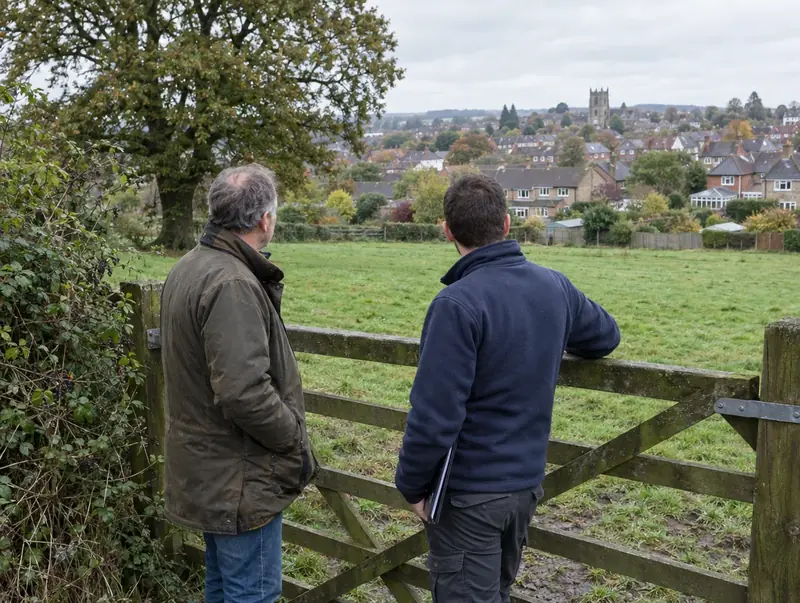
Selling farmland or paddocks in Clydebank for development usually means land on the edge of a town or village that could take new homes once planning policy allows. Value depends heavily on planning prospects, so many deals are options or promotion agreements that let you keep farming until permission is granted and the land is sold.
 Clydebank · G81
Free site appraisal
Tell us about your land and we will call you back. No cost, no obligation.
Prefer to talk? Call 0800 088 6248.
- Free site appraisalNo cost, no obligation
- Legal fees coveredReasonable fees, on options and promotion
- Nothing to pay upfrontOn promotion: we fund planning
- Direct purchaseSuitable sites, with or without planning
- UK-wideEngland, Wales, Scotland and NI
Our coverage in Clydebank
Clydebank sits about 6 miles north-west of Glasgow in Glasgow & the Clyde, in the G81 postcode district. If your land sits between towns, Renfrew, Bearsden and Paisley are the closest neighbouring places on our list.
In and around Clydebank, the land we appraise ranges from infill gaps along existing streets to land behind street frontages, including small holdings and pony paddocks. As Clydebank is in Scotland, applications are judged against National Planning Framework 4, and the buyer of land pays Land and Buildings Transaction Tax (LBTT).
A postcode and a rough boundary are enough for us to start a free appraisal of land near Clydebank.
Our approach in Clydebank
Access kept to retained fields
Deals can reserve access rights, service connections and drainage routes for the rest of your holding, so a new scheme does not cut off fields or buildings you keep.
Farm schemes considered
If the land is in an agri-environment or farm support agreement, taking it out may have consequences, including possible repayments. Check the scheme rules before you sign anything with anyone.
Overage on paddock sales
If you sell a paddock at its current value, an overage clause can secure a further payment if planning is later granted. We explain triggers, duration and how the obligation is secured.
Edge-of-settlement focus
Fields that adjoin existing homes, roads and services have the strongest planning prospects. Isolated fields deep in open countryside rarely suit housing, and if that applies to yours, we will say so.
How the rules work in Clydebank
Land sales in Scotland are concluded through missives, an exchange of formal letters between solicitors. Once missives are concluded they form a binding contract, and the buyer takes entry at settlement, then registers the title with Registers of Scotland. For land near Clydebank, missives can be made conditional on planning permission in principle, so the sale only proceeds if consent is secured. The buyer pays Land and Buildings Transaction Tax to Revenue Scotland.
In Scotland, NPF4 limits development on prime agricultural land, and rural housing is guided by its rural homes policy and the Local Development Plan. Croft land usually needs a decrofting direction from the Crofting Commission before it can be developed. Scottish agricultural tenancies carry their own statutory rights, so take specialist advice early.
| Who decides applications | The council as planning authority (or a national park authority in its area) |
|---|---|
| In-principle consent | Planning permission in principle (PPP), followed by approval of matters specified in conditions |
| Land registration | Registers of Scotland (Land Register of Scotland) |
| Developer contributions | Section 75 planning obligations, with Section 69 agreements sometimes used for simple one-off payments |
Questions about Sell Farmland and Paddocks in Clydebank
Can I sell a paddock for housing?
Often, if it sits within or next to a settlement and has safe road access. Paddocks behind existing homes are common development sites. Those in open countryside, or with poor access, rarely get permission. We check the development plan and site constraints before suggesting any route or deal structure.
What happens to my tenant farmer if I sell for development?
It depends on the tenancy. Some older agricultural tenancies give tenants strong security, while newer tenancies and grazing licences are usually more flexible. Planning permission for a non-agricultural use can sometimes support ending a tenancy, but the rules are technical and specialist advice is essential. We factor the tenancy into any deal.
What is an overage clause on farmland?
Overage is a promise by the buyer to make a further payment if a defined event happens after the sale, typically planning permission for a more valuable use. It is common when farmland sells at agricultural value. The key terms are the trigger, the share payable, the duration and how the promise is secured.
Can I keep farming while the land goes through planning?
Yes, in most option and promotion agreements. You stay in possession until the sale, and the agreement sets notice periods before the land is needed. It may restrict new long-term tenancies or works that could affect planning, such as removing hedgerows or trees without agreement.
Is Clydebank an area you cover for land?
Yes, we cover land in Clydebank and elsewhere in Glasgow & the Clyde, including Paisley, Bishopbriggs and Newton Mearns. Where a site suits us we can buy it directly, or set up an option or promotion agreement. On promotion there is nothing to pay upfront.
Read more: Sell Farmland and Paddocks · Guide: Biodiversity net gain for landowners: what it means for your land