
Architecture and Masterplanning in Powys
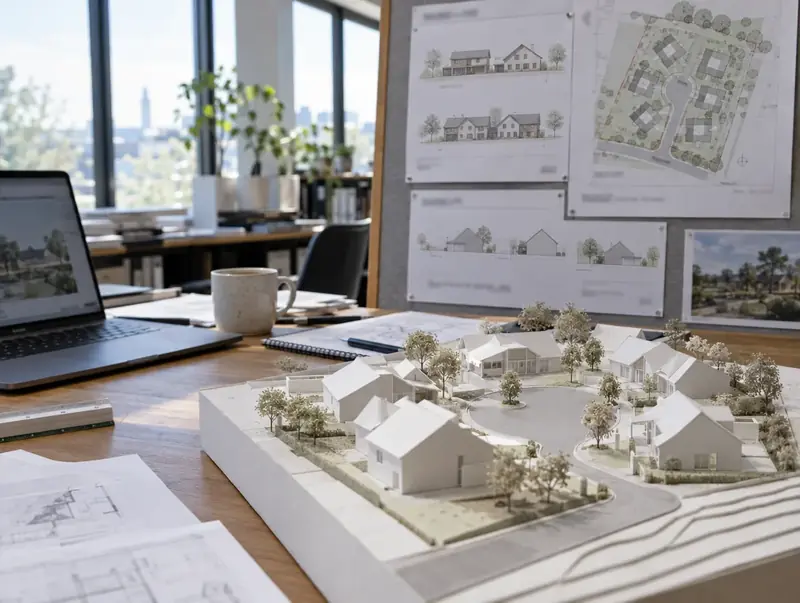
Before land in Powys can go for planning, someone has to show how many homes fit and how they will look. We start with a capacity study, then develop a masterplan that respects neighbours, trees, levels and drainage. The design is tested for cost and buildability at every stage, so what gets approved is something that can actually be built.
 Powys
Free site appraisal
Tell us about your land and we will call you back. No cost, no obligation.
Prefer to talk? Call 0800 088 6248.
- Free site appraisalNo cost, no obligation
- Legal fees coveredReasonable fees, on options and promotion
- Nothing to pay upfrontOn promotion: we fund planning
- Direct purchaseSuitable sites, with or without planning
- UK-wideEngland, Wales, Scotland and NI
Our work around Powys
Our Powys coverage takes in 4 towns and cities, centred on Newtown and including Welshpool, Brecon and Llandrindod Wells. Next door, we also cover Gwent, Mid Glamorgan and Dyfed. Our Great Barr head office in Birmingham is about 59 miles from the middle of Powys.
Near Powys, we look at land with an expired or ageing consent, in-principle consents that still need detailed approval and sites where the layout needs to change. Because Powys is in Wales, land titles are registered with HM Land Registry and transfers attract Land Transaction Tax (LTT).
Tell us about the site near Powys and we will explain how we would take it forward.
How we work in Powys
Buildability checked
We test every scheme for construction cost and practicality, so the consent we seek is for homes that can actually be built and then sold or let.
Capacity studies
We test several layouts to show what a site could realistically take, allowing for access, open space, drainage and the separation distances councils expect between homes.
Clear plans for landowners
We explain drawings in plain terms, so you can see how your land would be used, where the access runs and what land might be left over.
Design codes followed
Where a council has adopted a design code or design guide, we design to it and explain in the design statement how the scheme responds.
Rules that apply in Powys
Selling land in Powys follows the same legal steps as in England: heads of terms, then exchange of contracts, which makes the deal binding, and completion. Titles are registered with HM Land Registry, but the buyer pays Land Transaction Tax to the Welsh Revenue Authority rather than Stamp Duty Land Tax. Planning obligations are usually secured through a Section 106 agreement, with the Community Infrastructure Levy charged only where the council has adopted it.
In Wales, Planning Policy Wales puts placemaking at the centre of decisions, and the council's Local Development Plan sets local design policies. Most new developments need sustainable drainage approval from the SuDS approving body, which shapes layouts. Affordable homes funded by Welsh Government grant are usually designed to the Welsh Development Quality Requirements.
| National planning policy | Planning Policy Wales (Edition 12) and Future Wales: the National Plan 2040, supported by Technical Advice Notes |
|---|---|
| Local planning document | Local Development Plan (LDP) |
| Who decides applications | The local planning authority, usually the county or county borough council (or a national park authority) |
| In-principle consent | Outline planning permission, with reserved matters approved later |
| Land transaction tax (paid by the buyer) | Land Transaction Tax (LTT) |
| Land registration | HM Land Registry |
| How a sale becomes binding | As in England, a land sale becomes legally binding on exchange of contracts and finishes on completion, with the title registered at HM Land Registry. |
| Developer contributions | Section 106 planning obligations, plus the Community Infrastructure Levy (CIL) where the council has adopted it |
Your questions answered for Powys
Do new housing schemes need sustainable drainage?
In most cases, yes. National and local policy usually expects new developments to manage rainwater sustainably, for example with swales, ponds and permeable paving. In Wales, most new developments need separate approval from the local SuDS approving body. We design drainage into the layout from the start, because it can take up a real share of the site.
How many homes could my land take?
It depends on the size and shape of the site, the access, the character of the area, the open space and drainage the scheme needs, and local planning policy on density. Sites of the same size can have very different capacities. A capacity study is the reliable way to answer the question, and our free site appraisal gives an indicative figure.
Do I need an architect for a planning application?
Not by law, but a well-designed scheme with clear drawings stands a much better chance. Larger schemes also need specialist input from landscape architects, highways engineers, drainage engineers and ecologists. Where Land to Homes promotes land, we appoint and fund the design team as part of the planning work, so the landowner does not need to.
What is a design and access statement?
It is a short report submitted with certain planning applications that explains the design principles behind a scheme and how people will get to and move around it. In England and Wales it is usually needed for major development and for some smaller schemes in sensitive areas. Scotland and Northern Ireland set their own requirements for design statements.
Do you take on planning and building work in Powys?
Yes, on sites we buy, option, promote or develop in partnership across Powys, including Brecon, Newtown and Llandrindod Wells. We do not take on planning or building work for third parties as a consultancy.
Read more: Architecture and Masterplanning · Guide: Planning permission explained for landowners